
Asian hornet
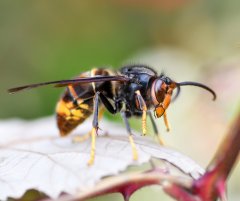
Both the European hornet and the Asian hornet are large wasps. The European hornet is native to the Netherlands and has a brownish-red thorax. The Asian hornet is smaller, has a black thorax and distinctive yellow legs, and is not native to the Netherlands.
In recent years, significant resources have been devoted to trying to eradicate the Asian hornet. These efforts have not been successful. We will therefore have to learn to coexist with the Asian hornet and minimize its impact as much as possible wherever necessary and feasible.
There are a number of new rules that you need to be familiar with:
- There is no need to report a hornet flying around, and it is no cause for panic
- Not every nest is dangerous
- Not all nests are being treated anymore
- Sometimes nests are located in inconvenient places close to people, and a decision may be made to remove them to prevent any potential danger
- The municipality is the first point of contact and will evaluate the situation
- Stay at least 5 meters away from a nest
Is the Asian hornet dangerous?
Asian hornets build nests in quiet places such as hedges, walls, sheds, or high up in trees. This large species of wasp does not attack without provocation. However, they will swarm to defend their nest if they feel threatened. So stay away from a nest.
A sting is no more dangerous than that of a common wasp, but it can be painful. As with other wasps or bees, you may experience an allergic reaction.
If hornets attack en masse when their nest is threatened, this can sometimes be dangerous because multiple stings can result in higher concentrations of venom. The Asian hornet may also try to spray venom into the eyes, potentially causing eye injuries. Therefore, be sure to avoid disturbing nests and stay at least 5 meters away from one.
What can you do?
Have you spotted a nest in a public space, your yard, or your home? Please report it to us via BuitenBeter at or through the BuitenBeter app, available for download in theGoogle Play Storeat or in theApp Store.
Please include a photo if possible. That way, we can come take a look. Do not go near the nest yourself.
If you only see one or more hornets flying around, you don't need to report it to us.
Please note: due to high volume, it may take a few days for us to respond. There’s no need to call or contact us again—we’ll get back to you as soon as possible. Thank you in advance for your patience!
Which nests do we treat, and which ones do we leave alone?
In 2026, the municipality will only remove nests in public spaces that:
- cause serious disruption
- being in a potentially dangerous place
- large nests in trees that are accessible by aerial lift and are dangerous
The following are not contested:
- Nests that are inaccessible
- Nests that are accessible but pose no danger.
We review each report to determine whether this is the case.
What does the Province do?
Through 2024, the Province of Limburg had all reported nests removed in an effort to stop the spread of the species. Unfortunately, this was unsuccessful. The species is now widespread, which is why the policy has changed. Starting in 2025, landowners will be responsible for taking any necessary measures themselves. However, the province, municipalities, and landowners will collaborate as much as possible in this regard.
The Province now only treats nests that
- pose a risk to nature in priority nature areas
- that pose a danger or cause a nuisance on private property.
Have you spotted a nest in a nature reserve or on provincial land?
- Please report this via the Asian hornet reporting hotline
- The province will follow up on this report itself based on its own prioritization. You will not receive any feedback regarding this.
- Reports are therefore not submitted through the provincial office, and reports of nests in locations other than nature reserves or provincial land are simply submitted through the municipality (as mentioned above).