
The vision in progress
Elaboration in instruments
The policy cycle is a new component of the Omgevingswet. The Environmental Vision marks the start of the policy cycle, in which the municipality sets out its long-term goals. Unlike the structural vision, the Environmental Vision is no longer a static document. The vision will be updated regularly. The ambitions and choices that arise from the Environmental Vision are then translated into environmental programs and the environmental plan.
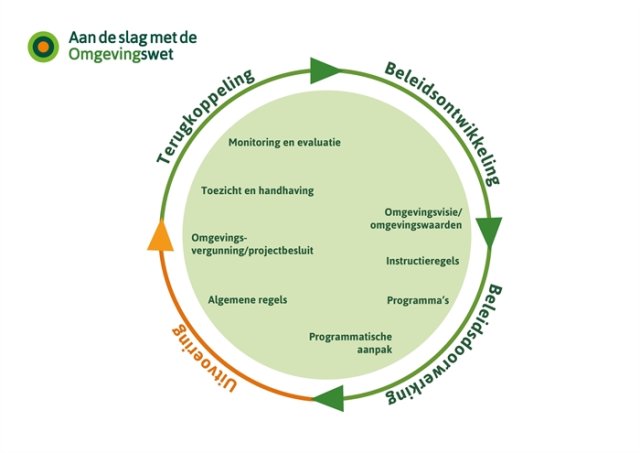
A textual explanation of the policy cycle of the Omgevingswet can be found on the website of the Information Point for the Living Environment.
Implementation of environmental programs
We can draw up an environmental program for a specific area or issue, as specified in the Environmental Vision. A program consists of actions we want to take to achieve our goal. It contains measures, a schedule, and what is needed in terms of commitment. TheOmgevingswet
Omgevingswet a number of mandatory programs, including noise. Voluntary environmental programs can also be established.
In addition to thematic programs, such as a program for health (Vie), we can also establish area programs for specific areas where developments are expected. In these programs, we will tackle cross-domain, social, and physical challenges.
When drawing up the programs, the strategic principles for each type of area, with the preconditions described in Chapter 4, are further elaborated. The environmental program is an instrument of the municipal executive. There are no formal requirements for drawing up a program.
Elaboration of Environmental Plan and Environmental Permit
The environmental plan describes the rules, and the environmental permit officially authorizes activities that may have an impact on the physical living environment. Examples include cutting down a tree or constructing a building. The environmental plan is binding for everyone. Once the Environmental Vision has been adopted, the municipality will start working on an area-wide environmental plan for the entire municipality (to be adopted before 2032).
New environmental safety policy will be further elaborated in the Environmental Plan. The safety region offers four core values and six design principles relating to environmental safety. The municipality will incorporate these principles into the elaboration of the environmental plan and into the processing of environmental permit applications.
Review of structural vision
The current long-term visions have proven their worth but are now outdated and in need of renewal. A lot has happened in Kerkrade between 2010 and 2025. Various large-scale physical projects have been completed, often in collaboration with other parties, including housing associations. Clear examples in the city center are the Center Plan (shops, homes, Martin Buberplein, realization of Hub (library and theater) and Vie (indoor swimming pool, sports facilities, Innovation Hub, and parking garage). In the Heilust neighborhood, a large-scale redevelopment has taken place, with the construction of Park West and the realization of an MFA in the former church. In Bleijerheide, the circular area development SUPERLOCAL has been realized. The Rolduckerveld redevelopment is in full swing. The Rodaboulevard (retail and leisure cluster) has also been further developed, the Discovery Museum (Museumplein) has been expanded, and the station area has been redesigned, the GaiaZOO zoo has been expanded, and the City Park has been redesigned.
Various smaller developments have also taken place, including the construction of tiny houses and the planting of life tree forests at three locations in Kerkrade. In terms of infrastructure, the Buitenring Parkstad Limburg (N300) was constructed between 2015 and 2017, which was an important development for improving accessibility to Kerkrade and the entire Parkstad region. Since 2018, various business parks have also been made more accessible. This has led to a decrease in vacant commercial plots, an acceleration of the restructuring of Kerkrade's business parks, and an increase in employment in the Medtech sector and logistics/distribution due to the favorable location in Western Europe.
Regional cohesion
Parkstad region
Previously, there was a regional structural vision at Parkstad level, the 'Intermunicipal Structural Vision Parkstad – 2009'. With the introduction of the Omgevingswet there Omgevingswet now only an Environmental Vision at national, provincial, and municipal level. That is why the Parkstad region has opted to draw up a regional coordination framework, which will be incorporated as a building block in every Environmental Vision. This will ensure that regional qualities, tasks, and ambitions are safeguarded in a uniform manner. The regional coordination framework was adopted by the municipal councils (Beekdaelen, Brunssum, Heerlen, Kerkrade, Landgraaf, Simpelveld, and Voerendaal) in the first quarter of 2023. The regional coordination framework is not a rigid framework with strict planning principles, but an inspiring vision aimed at bringing together qualities and challenges at the regional level. It is also a positioning document for the wider region: where do we see opportunities for further cooperation and spatial structure reinforcement as a vital border region? The regional coordination framework is currently being updated on the basis of 'Parkstad Limburg offers space! Our future story for 2040'. A new version of the regional coordination framework is expected to follow in 2026.
From a regional perspective, there are several important facilities, opportunities, and developments that the municipality must take into account:
- Collaboration within the Parkstad region to develop a spatial vision for the circular economy. This includes jointly drawing up an implementation program for a circular Parkstad in 2050.
- Regional cooperation within the framework of the Regional Energy Strategy (RES) South Limburg, in which Kerkrade, as part of the Parkstad Limburg subregion, contributes to the energy transition. This cooperation focuses on energy saving, sustainable electricity generation, and the heat transition.
- Expansion of the Terwinselen high-voltage substation (municipality of Heerlen).
- New Narrative: “Parkstad Limburg offers space! Our future story for 2040”.
- Good coordination in the areas of housing and employment; accommodating different target groups.
- New developments in the municipalities of Heerlen (housing and retail) and Landgraaf (Rouenhof holiday park, locations for housing on Europaweg-Zuid, north of Eygelshoven).
- Regional commitment to "Medlands Parkstad." Parkstad is home to several international companies in the medical technology sector that provide essential and advanced healthcare resources, medicines, and equipment. Demand for these products is high and will only continue to grow in the future.
Link to National and Provincial Environmental Vision
The national government and the province of Limburg have set out their vision for the future of how we live, work, and spend our leisure time in the Netherlands in the National Environmental Vision (NOVI) and the Provincial Environmental Vision (POVI) respectively. These documents address complex issues and establish a hierarchy of themes and possible solutions. For example, there are various transitions underway in the areas of housing, agriculture, the economy, and energy, all of which involve a significant demand for space. One of the most important priorities of the NOVI is that all these transitions must be viewed in conjunction with each other, with the quality of the environment being central.
The NOVI therefore applies three assessment principles:
- Combinations of functions take precedence over single functions;
- The characteristics and identity of an area are central;
- Offloading is prevented.
The South Limburg region has been designated a NOVEX area due to the high number of overlapping challenges it faces. The sum of spatial claims exceeds the capacity of the landscape. The national government, the province, and all municipalities in South Limburg have jointly drawn up the 'NOVEX Development Perspective'. This outlines three themes that are preconditions for the development of the South Limburg region: circular economy, green-blue quality, and urbanization close to IC hubs. The latter two in particular receive considerable attention in Kerkrade's Environmental Vision.
At the same time as drawing up the municipal environmental vision, the Province of Limburg is also working on a new Provincial Environmental Vision (POVI). The POVI sets out the long-term vision (2030-2050) for the physical living environment. It covers a wide range of topics, such as housing, soil, infrastructure, energy, economy, agriculture, water, nature, landscape, and cultural heritage. The broad outlines and structures set out in the POVI in areas such as regional connections, a healthy living environment, a sustainable economy, and a secure energy supply are reflected in this Environmental Vision. However, the draft POVI includes a number of points that are not in line with Kerkrade's Environmental Vision. The municipality has submitted its opinion on the following topics:
- Energy theme: designation of areas as 'wind turbine search areas' and 'wind turbine development not excluded'. The designated locations are relatively small in size and are not realistic, taking into account other interests such as nature, cultural history, landscape, and proximity to urban areas.
- Map material does not correspond with Kerkrade's Environmental Vision. Working sessions have been held between the municipality and the province on this subject: the designations and boundaries of Interwoven Areas, Green-Blue Agricultural Zone, Limburg Nature Network, Primary Agriculture, and Urban Area.
- In the area of housing, the province encourages all municipalities to achieve their 30% social housing target. In Kerkrade, however, the situation is reversed: the municipality has well over 30% social housing, and in order to achieve a balanced housing stock, this percentage must be reduced.
- Designation of the Dentgenbach industrial estate as being of 'provincial importance' and having potential for the circular economy. This is at odds with the municipal environmental vision, which actually lowers the environmental category for industrial estates given their location near residential areas and adjacent to nature reserves (Strijthagerbeekdal (municipality of Landgraaf), Anstelvallei, and Wormdal).
Euregional context
Kerkrade is located directly on the German border with Herzogenrath. Since January 1, 1998, the municipality of Kerkrade and the city of Herzogenrath have formed the Eurode Public Body, a unique public-law partnership. This partnership enables formal decision-making across national borders and focuses on, among other things, economic strengthening, improving traffic infrastructure, and stimulating regional business and employment. In addition to the formal partnership, other factors also play a role in the Euregional location of the municipality of Kerkrade:
- The lives of the residents of Kerkrade and Herzogenrath extend beyond the national border. People from Kerkrade shop in Herzogenrath (e.g., Kaufland) and vice versa. The weekly market in Eygelshoven and Rodaboulevard are popular attractions for German visitors.
- Cross-border nature reserve The Wormdal, between Eygelshoven and Rimburg, will undergo 'renaturation' of the Worm, which will also have a positive effect on the German part of the Wormdal. The 'knopenlopen' walking trails are also important and connect both sides of the border.
- Kerkrade is located in the Roer river basin, of which the Worm and Anselderbeek are important tributaries. The local water system in Kerkrade is heavily dependent on developments and water management in Germany upstream (south of the municipality of Kerkrade). Coordination and cooperation between Dutch and German authorities, including the Wasserverband Eifel-Rur, will become increasingly important, taking climate change into account. The plan is to draw up a river basin plan for the Roer within a few years.
- The Drielanden train is a regional train connection in South Limburg that connects Kerkrade with cities in the Netherlands (Heerlen and Maastricht), Germany (Herzogenrath and Aachen), and Belgium (Liège). The last stop in the Netherlands is at the Eygelshoven Markttrain station in the municipality of Kerkrade.
- Kerkrade is working with partners in the Netherlands and Germany to develop cross-border cooperation for energy projects, in order to work together on the energy transition within the Eurode association. Just across the border in the city of Herzogenrath, for example, is one of the largest solar parks in North Rhine-Westphalia. The solar park is expected to be expanded further and there are plans to build a hydrogen power plant. The Saint Gobain glass factory in Herzogenrath wants to generate heat from residual heat. This could form a sustainable heat source for a cross-border heat network. Since August 2025, Kerkrade and Landgraaf have been working with Herzogenrath on the Interreg project 'CROSS_HEAT'.
- Search area for wind turbine construction around Aachen and Herzogenrath, close to the national border (impact on the southern part of Kerkrade and the northeastern part of Kerkrade).
- Research will be conducted into the possibilities and opportunities for creating cross-border cycle routes to Herzogenrath and Aachen. A fast main cycle route between these cities and the Parkstad region could be a major asset for cyclists, connecting the cities in the Euregio and thereby promoting healthy mobility.
Implementation agenda
This Environmental Vision sets out various objectives and activities to be implemented over the next 25 years. Below is an overview of new environmental programs, potential projects, and measures for the short, medium, and long term.
Current environmental programs
These programs are existing and originate from the 2022-2026 municipal program "Continuing to build a vibrant Kerkrade together." They are:
- Thematic program Vie – Life in motion (Social domain, health)
- Thematic and mandatory program Action Plan Noise (Environment and Sustainability)
- Noise maps and action plans are updated every five years.
- Kerkrade-East Area Program
- Area program “Kerkrade-Centrum Action Plan”
New environmental programs
Based on the storylines and ambitions, work will be done on the following programs in the coming years:
- Thematic Program Sports, covering topics such as sports, accommodations, and the thematic subprogram Exercise in Public Spaces (BIOR)
- Thematic program Housing/public housing
- Thematic sustainability program, consisting of the neighborhood implementation programs Transition Vision for Heating, Energy Vision, and subprogram Water and Climate Adaptation (regional and local implementation)
- Thematic program Green (drawing up a green development plan (including policy))
- Thematic program Spatial Quality. Consisting of heritage, cultural history, landscape, and spatial quality/aesthetics (including policy).
2025–2030
(National) goals:
- The Clean Air Agreement (SLA) in 2030 also includes a monitoring obligation for air quality.
- The European Water Framework Directive must be complied with by 2027.
- By 2030, the perceived health of Kerkrade residents will be at least equal to that of South Limburg.
Possible projects and measures:
- Conduct research into the possibilities of applying dynamic water level management to the Cranenweijer reservoir (limiting flooding in Eygelshoven and providing additional water storage for longer periods of drought).
- Conduct research into removing the culvert covering the Anselderbeek and Strijthagerbeek streams in the center of Eygelshoven.
- Reducing soil erosion in the landscape framework (outlying areas) by (eventually) no longer allowing arable farming on the steepest slopes. There has been a change in land use; in these areas, grassland is preferable, preferably in combination with the creation of small landscape elements. This can be achieved by incorporating new rules into the Environmental Plan and in new lease agreements (land policy).
- Expand the number of municipal monuments. This requires the development of municipal policy that further substantiates the preservation of cultural-historical heritage and archaeology. See the "Spatial Quality" program.
- Continue restructuring in the Rolduckerveld and Bleijerheide/Nulland neighborhoods.
- In order to improve quality of life and achieve a more balanced population composition (both in terms of demand and supply), instruments such as the Special Measures for Metropolitan Issues Act (Rotterdam Act) and municipal housing regulations will be used.
- Possible construction of a heating and cooling network in Kerkrade-West and the city center
- A Regional Water and Climate Adaptation Program will be drawn up in 2025-2026. This program will focus on tackling flooding, drought, and heat stress, as well as improving the quality of groundwater and surface water.
- Convert ribbons into bicycle lanes, starting at the Bleijerheider-Pannesheiderstraat ribbon.
- Strengthening city entrances and edges (for example, in Eygelshoven and Kerkrade Center).
- Three new elementary schools will be built in Kerkrade-Oost, one of which will be completed by 2030 and two in the period 2030-2040.
- Future of sports and play facilities (relationship with exercise/health).
- Expansion and reinforcement of the energy network with at least 100 small transformer stations and at least three medium-voltage stations, and expansion of the Terwinselen high-voltage station.
- At the Dentgenbach business park, companies are launching a pilot project to coordinate energy generation and consumption.
- Remediation of mine shafts and part of the risk zones affected by the after-effects of mining in the
municipality of Kerkrade
2030–2040
(National) goals:
- 2040 energy neutral in the Parkstad Limburg region
- 50% circular by 2040
- More than 70% of homes in Kerkrade comply with the 3-30-300 rule (report mark of 6 or higher).
Possible projects and measures:
- Restructuring of Mucherveld and parts of Eygelshoven.
- Stream restoration by removing the culvert covering the Anselderbeek stream in Eygelshoven.
- Redesign and greening of Nieuwstraat/Neustraße.
- Expanding the cold and heat network (eastern part of Kerkrade).
- Train continuing from Kerkrade-Centrum to Kerkrade-West
- Expanding the energy network across the border.
- Remediation of mine shafts and part of the risk zones affected by the after-effects of mining in the municipality of Kerkrade
2040–2050
(National) goals:
- By 2050, all buildings will be off natural gas.
- Kerkrade ranks among the top five safest cities in South Limburg.
- 100% circular by 2050
- 90% of homes in Kerkrade comply with the 3-30-300 rule (grade of 6 or higher).
- By 2050, the total amount of paved surfaces in the municipality of Kerkrade will have decreased by 20% compared to 2025. This is a very important step toward creating a climate-proof and water-robust residential and living environment.
Financing ambitions and tasks from the Environmental Vision
The Environmental Vision includes many ambitions and tasks that give substance to Kerkrade's long-term vision. We will work on this together with various parties. The municipality cannot predict all trends and developments. Developments such as changes in financial resources, available materials, and personnel may delay the implementation of the Environmental Vision. New regulations from Europe, the national government, or the province of Limburg (
) may also influence the choices and ambitions described in this Environmental Vision. If this is the case, the vision will be adjusted (in part).
In order to address the social issues and ambitions outlined in this vision (the four storylines), we will pursue a more active (land) policy for various locations in the urban area and in the outskirts. This means that, depending on the area in question, we will make use of the available instruments under private and public law. This has been laid down in the land policy memorandum.
Financial resources are needed to achieve the ambitions and goals of this vision. This is not only provided by the municipality, but also in collaboration with other authorities, companies, and (markt) parties. Residents can also contribute, for example by making their homes more sustainable and creating a façade garden. When establishing the Environmental Vision, it is difficult to obtain a complete picture of all the implementation costs arising from the ambitions and tasks. For the time being, the financing is therefore linked to existing programs and projects.
Through the municipal fund, the municipality receives annual funding, part of which we use to implement the tasks outlined in this vision. We make use of the available subsidies for various projects. It is important to collaborate with other authorities and (markt) parties and to continue investing in order to achieve our goals.
The costs are covered by the municipal organization through the (construction) fees and prior agreements. This also contributes to improving the quality of the public space of a (construction) plan and its surroundings.
The scheme for voluntary financial contributions is being investigated. This scheme offers the possibility of making agreements about contributions to broader developments in a particular area, such as working on green, healthy, exercise-friendly, and attractive public spaces. This means that land policy is not only a means of covering costs, but also an instrument for steering towards a high-quality and future-proof living environment.
Monitoring
The Environmental Vision provides a dot on the horizon, but is never completely finished. At least every four years, we review whether we are still on the right track and whether adjustments to policy or tasks are necessary. It is particularly important to determine whether the ambitions set can still be achieved or whether we need to adjust them. To this end, as a municipality, we use the policy cycle and monitor indicators for each storyline. In this way, we ensure that our vision continues to align with social needs, issues, and developments in the interests of the municipality of Kerkrade.
Monitoring environmental aspects that are important to the objectives set out in the Environmental Vision is of great importance. This requires a monitoring framework that enables the municipality to periodically assess the state of the living environment using clear and reproducible indicators (
). The data from the Photo of the Living Environment and the OER provide a good basis for this.
Monitoring framework for the Kerkrade Environmental Vision
We have established a number of key indicators for each storyline to help us monitor whether we are achieving our ambitions. We have chosen to focus on these indicators because we do not have the capacity to monitor all aspects of the physical living environment on a frequent basis. By focusing on the most important indicators that are directly related to our storylines, we can effectively monitor whether we are achieving our ambitions and whether we need to make adjustments. We seek to align ourselves as much as possible with existing monitoring sources, such as the Municipal Health Service (GGD) health monitor, the Parkstad Climate Atlas, and the Parkstad monitor.
Liveable city
Indicator | Measurement method / Source |
|---|---|
| Percentage of bicycle use compared to car use | Mobility monitor, traffic data |
| Average distance to amenities (in meters) | GIS analysis, municipal data |
| Noise and air quality (Atlas Leefomgeving score) | Atlas Living Environment / GezGezondeleefomgeving.nl |
| Liveability score (Parkstadmonitor) | Parkstadmonitor.nl |
Multi-generational city
Indicator | Measurement method / Source |
|---|---|
| Percentage of social housing/private rental/owner-occupied homes | Housing stock figures, BAG, CBS |
| Number of residents who feel lonely (percentage) | GGD Health Monitor |
| Number of meeting places | Municipal inventory |
| Lifestyle: percentage of overweight people, percentage of people who get enough exercise, life expectancy | GGD, VIE monitor |
Working city
Indicator | Measurement method / Source |
|---|---|
| Number of jobs | UWV, CBS, municipality |
| Percentage of vacancy rate in business parks | Municipal inventory |
| Labor participation, demographics (declining birth rates, aging population, migration) | CBS, Parkstad Monitor |
Climate-resilient city
Indicator | Measurement method / Source |
|---|---|
| Percentage of buildings that meet the 3-30-300 rule | Quick scan, GIS, field research |
| Areas with extreme heat stress | Parkstad Climate Atlas |
| Percentage of greening/paving of public space | GIS, aerial photographs, field surveys |