
Working Together to Build a Healthier Region
How can we ensure that research findings are more effectively applied in practice? And how can experiences from municipalities and neighborhoods, in turn, guide research? Driven by a shared ambition to make a positive impact in the region, Vie Kerkrade and Maastricht UMC+ are collaborating to ensure that research findings demonstrably contribute to better health and vitality in the South Limburg region.
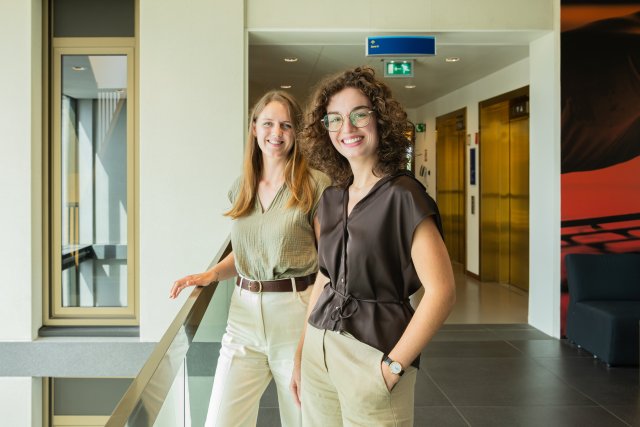
One concrete step in this direction is the secondment of Britt Merx, a welfare policy officer at the municipality of Kerkrade, to Maastricht UMC+ as the Knowledge and Expertise Center for Prevention and Vitality. Together, they are working to strengthen the link between policy, practice, and science.
“We’re realizing just how much knowledge there already is”
Through an innovative approach in local neighborhoods, Vie is giving new impetus to regional health and vitality in the municipality of Kerkrade. At Vie, health is viewed from a broad perspective. It’s not just about the absence of disease, but also about quality of life, participation in society, and a stable, healthy living environment. Issues such as poverty, education, sports, and social cohesion play an important role in this. Britt: “Municipalities and professionals have many questions regarding health and prevention. At the same time, we see how much knowledge is already available through research. The challenge often lies in connecting those two worlds.” Conversely, experiences from neighborhoods and municipalities also offer valuable insights for researchers. They highlight the issues that are relevant in practice and where there is a need for new knowledge. This interaction aligns seamlessly with the role that Maastricht UMC+ sees for itself as a Center of Knowledge and Expertise in the field of prevention and vitality. Lieve Vonken, prevention and vitality advisor: “There is an enormous amount of scientific knowledge within Maastricht UMC+ on the topic of prevention. However, knowledge and practice don’t always find each other naturally. That is precisely why it’s valuable to work together to discover what’s needed to apply that knowledge more effectively.”
Literally closer together
The collaboration is taking shape in part through Britt’s part-time secondment to Maastricht UMC+. For both organizations, this is a way to bridge the gap between practice and science. Britt: “Because I’m familiar with both municipal practice and the world of research through my master’s degree in Health Promotion, I could already see where opportunities lay. This collaboration gives me the chance to bring researchers and municipalities closer together, so that scientific knowledge can be better applied in practice.” According to Lieve, Britt’s deep understanding of municipal practice is a valuable asset to the knowledge and expertise center. “Britt brings experience from both policy and implementation. That leads to different conversations and new insights. It helps us take an even closer look at what municipalities and professionals actually need.”
From Demand to Knowledge
One of the first initiatives this collaboration is contributing to is an accessible information desk being developed within Maastricht UMC+. Britt: “As a municipality, you sometimes aren’t sure where to turn with a specific question—even though relevant knowledge, research, or experts are often already available.” “With an information desk, we want to make that access easier. It doesn’t have to be complicated,” adds Lieve. “Sometimes, the most important thing is simply for the right people to find each other more quickly. By making knowledge more accessible, insights can also be better utilized in policy and implementation.”
In addition, meetings are organized where policymakers and researchers come together—not only to share knowledge, but above all to better understand each other’s ways of working. What does it take to properly formulate a practical question for researchers? And how do you translate research findings in a way that makes them useful for policy and implementation? Lieve: “Researchers view issues differently than professionals in the field. By meeting more often, we develop a better understanding of how these two domains can reinforce each other.”
Learning and Growing Together
The collaboration is still very much a work in progress. Britt: “We’re discovering together what works. That requires trial and error, adjustments, and reevaluation. But it’s precisely because we’re working so closely together that new ideas and connections are emerging.” Lieve also sees great value in this for the future. “At Maastricht UMC+, we’re strongly committed to forging stronger links between science and practice. For example, through this collaboration with Vie. In this way, we’re building, step by step, a tightly connected prevention landscape. I see this initiative as one small cog that contributes to a future learning ecosystem in which research and practice are structurally linked throughout South Limburg.”
A Stronger Region
For both Vie and Maastricht UMC+, this partnership represents an investment in a stronger region. By connecting clinical practice, policy, and science, a network is created in which knowledge is shared more quickly, new insights emerge, and residents ultimately benefit from better-informed choices regarding health and well-being.