
The ambitions along four storylines
The Kerkrade Environmental Vision seeks solutions that go beyond the problems, in order to return to the core qualities that are so important to the municipality. To this end, four storylines have been developed, each of which focuses on principles that the Environmental Vision wants to use to make Kerkrade future-proof: 1 livable city, 2 working city, 3 multi-generational city, and 4 climate-proof city. These storylines are further elaborated in this chapter. The accompanying Maps show where spatial issues or changes play a role.
Across the storylines, however, we also see a number of themes that cannot be captured in a single storyline or area type. These are the themes of health and broad prosperity, landscape and heritage, and energy security. These are themes that play an important role now and will continue to do so in the future. These themes are addressed separately within each storyline.
With the Vie program, Kerkrade aims to bring perceived health up to the level of South Limburg. Within South Limburg's health policy, the goal is to close the gap with the rest of the Netherlands by 25% by 2030. Working on health involves, on the one hand, protecting citizens from unhealthy influences such as noise pollution, poor air quality, or dangerous situations. These themes are environmental in nature and are safeguarded by European, national, and local environmental laws and regulations. We comply with laws and regulations in order to achieve a healthy and safe living environment
. At the same time, there is also a promotional perspective, whereby environments are designed in such a way that healthy behavior is possible. This approach is based on positive health. This broader approach contributes to people's ability to cope with the physical, emotional, and social challenges in life. And to take as much control as possible. In order to design the living environment in a way that promotes health, the GGD GHOR has defined core values for a healthy living environment. To show how the storylines are linked to working on a healthy living environment, a link to these core values is always provided.
Additional advice and research that can be used in the further development of locations and programs can be found on the GGD GHOR website.
Liveable city, where amenities are close by
Because Kerkrade originated from several neighborhoods, it does not have a single center. The municipality is a network of several neighborhood centers connected by ribbon structures. Many neighborhoods have their own identity, landmarks, and community. This structure offers opportunities to set up neighborhoods based on the principle of proximity. This means that you do not necessarily need a car to access facilities (education, Health, shopping, sports, culture) and social activities. When amenities are close by, it encourages healthy exercise (walking or cycling) and provides more opportunities to meet neighbors and other local residents.
When working on nearby facilities, the following principles are key:
Complete neighborhood hubs
Focusing on proximity in one's own neighborhood means that the various community centers must remain vital. Preferably with a complete range of daily amenities, from supermarkets to schools and Health walking distance of every home. In doing so, we are not only looking at retail. Neighborhood centers only become hubs when they are also lively places. We can achieve this by connecting schools, Health and social facilities, new homes, and mobility hubs to the neighborhood center.
Liveliness and interaction also require space to be allocated for unexpected events. Public spaces must be safe and easily accessible. They provide the community with space to relax, play, and organize festivities. This could be done in combination with existing cultural heritage to preserve the social functions of these places, always with a view to greening for cooling, climate adaptation, and attractiveness. A concrete example is the entrance from the Julia business park to the center of Eygelshoven, where the parking lot on Hermanstraat could potentially be used as a mobility hub. A green entrance could be developed along Putstraat between the Markt the parking lot.
Customization
Focusing on vital neighborhood centers does not simply mean adding facilities and shops. The reality is that in many places there is already too little support to maintain these functions. Choices will therefore have to be made about where it is realistic to concentrate facilities and shops. Where this is not the case, consideration should be given to converting retail space into housing or other functions. A solution must also be found for parking. Facilities must remain accessible without public space being completely taken up by stationary cars. This requires tailor-made measures.
Another form of customization can be found in small public spaces that serve as landmarks or meeting places without necessarily having all kinds of functions or facilities attached to them. It is important to continue to guarantee quality here as well.
Space for neighborhood initiatives (residents and associations)
With this vision, the municipality also wants to encourage initiatives in the neighborhood. Every neighborhood has a number of places where residents meet in their free time. For example, at the soccer club, the community center, the music club, or the markt. However, some of these places are under pressure due to a decline in membership or volunteers. We need to look carefully at where we can combine associations or spaces within the neighborhood in order to maintain sufficient support. The creation of multifunctional sports facilities
is a good example of this. For healthy urban living where sports, recreation, and play have a place, but also because it is precisely these kinds of social connections that form the basis for every municipality. One concrete project is the future of the Patronaat (Bleijerheide). We are developing this community center into a social neighborhood hub, where residents can meet and go for support. This will be further elaborated in the Kerkrade-Oost ambition plan.
A network of attractive and safe ribbons
The historic ribbon roads form the links between important daily destinations. They are, in fact, the lifelines of the city. The ribbon roads that lead to neighborhood hubs are being transformed into bicycle streets in some locations. These are attractive places to cycle and walk in a greener environment. Cars are guests and are only used for destination traffic. Accessibility for emergency services remains guaranteed. Because these ribbons have been around for a long time, there is also a lot of architectural quality to be found. These little gems can be put to good use as landmarks and to give a place its identity. With the transformation of the ribbons, they will also become more attractive as a residential environment, which offers development opportunities for vacant properties.
The aspect of safety is highlighted in several places in the Environmental Vision, with a focus on traffic safety. However, a livable city also requires social safety and crime prevention. This remains one of the municipality's priorities. Various measures, particularly in the city center and residential areas, will directly or indirectly contribute to safety. Some examples of this are: converting vacant shops into homes, making city centers more compact to combat vacancy, converting vacant rear areas into parking, green spaces, or small-scale housing, no new addition of garage boxes in residential areas, and the multifunctional use of squares to create space for sports, games, exercise, and socializing. In the development of environmental programs, further research can be conducted into what a structural approach might look like.
Health and broad prosperity
The liveable city operates on the principle of proximity to ensure that Kerkrade residents can reach daily amenities within walking and cycling distance. The exercise-friendly routes and attractive city center areas contribute to increasing the number of residents who meet the exercise standard, but also to social issues such as loneliness and social safety. The historic ribbon developments and centers must once again become the community hubs they once were. Places where people want to be, stay, and meet each other.
The Liveable City therefore aligns with core values #2: Attractive places, #4: Housing and heavy traffic, #5: Amenities nearby, #6: Active transport, and #7: Cycling and public transport connections.
At the same time, we also want to eliminate negative influences from the residential environment. The measures relating to mobility (priority for bicycles on the roads, lower speeds for cars, and the exclusion of freight transport in residential areas) will also improve air quality and reduce noise pollution. The aim is also to improve traffic safety around important locations (schools and centers).
Landscape
Within the landscape framework, neighborhood hubs and ribbons form neighborhood structures that Health primarily support Health in terms of attractive space, sufficient cooling (shade), and a green-blue basis (climate adaptation). These areas feature small green structures that do not necessarily need to be connected to larger green areas, but do provide space for greenery that is also attractive to more species of plants and animals (increasing biodiversity).
In some places, there is reason to connect larger structures. Sometimes to improve the quality of the place, sometimes to enhance the surrounding landscape. Examples of such places are in Eygelshoven, where there are opportunities to remove the covering of the Anselderbeek stream, or Doctor Ackensplein in Bleijerheide, where an old dry valley and a church path provide access to the countryside.
Heritage
Currently, the municipality has no policy on heritage and cultural history and an outdated aesthetic policy that is no longer workable in daily practice. That is why each storyline also includes a look at the vision or opportunities surrounding heritage. Objects and structures are further highlighted in the map material.
Precisely because the community centers and ribbon developments are the oldest structures in the municipality, there is also a great deal of heritage to be found here, such as church buildings, roadside crosses, and houses. Heritage that is not always protected or needs to be protected, but which contributes to the recognizability of the area. Looking to the future, it is important to continue to care for all heritage (including intangible heritage). This includes looking at new functions for iconic buildings. For example, converting vacant churches into homes or social functions.
Energy security
Energy security is an important prerequisite for a livable city. Residents must be able to rely on a reliable energy supply. Strengthening a local and sustainable energy system contributes to the functioning of essential facilities such as homes, schools, and healthcare institutions. By also organizing energy generation, smart storage, and infrastructure nearby, the city becomes less dependent on external sources and facilities remain accessible and operational. Cross-border measures can also play a role here, such as the possible Nivelsteiner Groeve hydrogen plant and the use of residual heat from the Saint-Gobain glass factory in Herzogenrath.
Working city, where working and living are inextricably linked
Kerkrade has various areas of activity: locations Health shops, offices, and Health , but also industrial estates where small and medium-sized enterprises (SMEs) and large-scale businesses are located. Some of these industrial estates are located between the urban area and the rural landscape (outlying area), often on former mining sites. Others are well positioned along highways and expressways such as the Buitenring Parkstad (N300) and the A76, which connect the Parkstad region and Kerkrade to the Euro region. This makes the region attractive to companies with an international market, such as the logistics and MedTech sectors. As a result, the number of jobs has increased significantly in recent years.
The next step is to examine the use of space and the working environment, so that we can continue to develop Kerkrade as a working city. This means striving for healthy and attractive working environments, connecting SMEs and education, and ensuring an adequate supply of housing and facilities to attract and retain employees and talent. The economy must contribute to broad prosperity in Kerkrade.
The following principles are central to Kerkrade as a working city:
A pleasant working environment
The industrial estates cover 17% of the municipality's total surface area. This means we can make a difference here by improving the quality of the layout. Partly for climate adaptation, but also to create a healthy working environment for employees. A place where they can stay (
, hold meetings or have lunch outside), walk or even exercise. To this end, the business parks will be better connected to the urban area and the surrounding countryside so that they are not islands in themselves, but truly part of the city. Connections for slow traffic (pedestrians and cyclists) will be created, ensuring good and safe accessibility to and from the nearby train stations. Kerkrade's border location will be exploited by also creating a good bicycle connection to Herzogenrath station. The shared bicycle stations can also be further expanded. This will enable employees to use alternative, healthy means of transport to get to work.
Some work areas ensure that the adjacent rural areas are hidden and difficult or impossible to reach from residential areas. Examples include the Juliaterrein industrial estate for the Wormdal and the Dentgenbach industrial estate for the Strijthagerbeekdal (municipality of Landgraaf). When redeveloping industrial estates, attention must also be paid to improving access to the adjacent outdoor area (
). This will enable employees and residents to make more use of the green areas. It will also contribute to the quality of the working environment and the attractiveness of the business climate for companies.
Cherishing local SMEs
We are committed to improving the quality of local SMEs in the city. There is a need for a distinctive profile in relation to the (supra)regional large-scale retail and leisure establishments on Rodaboulevard. This also means that we are making room for small entrepreneurs in interesting locations in the city, provided that this does not cause any (environmental) nuisance to the residential environment. Sometimes cultural heritage sites offer opportunities to house small start-ups as pioneers.
Growth in employment also for local residents
The Environmental Vision focuses on creating more workplaces per hectare. This requires employers and owners to use space efficiently. Efforts are also being made to encourage different types of activity in order to prevent a monoculture.
A place for the energy transition
Work areas often form an important link in the energy system. As (large) consumers, but also as places for generation. Here are the large roofs for solar energy, here is potential residual heat for the heat network. In this way, business parks can supply sustainable electricity (and heat) to neighboring neighborhoods or to other businesses.
We remain committed to utilizing rooftop electricity generation in new buildings. We are also looking to combine this with green roofs (water retention, biodiversity, and heat stress reduction). However, we will also need to look at more energy-neutral business premises and focus on (energy) partnerships in order to use energy and grid congestion (energy hubs) in a smart way.
In order to realize a heating and cooling network, pipes and (underground) structures will need to be installed to connect buildings in Kerkrade (particularly in Kerkrade-West and parts of Kerkrade-Oost) to this network. The preferred routes are already known. Space will need to be reserved in working and residential areas for the heating network, but also for network reinforcement, energy storage, and possible smart grids. This will need to be taken into account in the (re)design of public spaces and the greening of the city.
Health and broad prosperity
Work is important in providing residents with a solid economic foundation. We therefore maintain room for job diversity and encourage entrepreneurship within the municipality. The working city is linked to core values #5: Local amenities and #7: Cycling and public transport connections. New developments also take environmental issues such as noise, air quality, odor, and environmental safety into account. We comply with the legal and nationally applicable standards, such as the Clean Air Agreement (SLA). This means that we focus on lower environmental categories for work areas and take into account the location characteristics of each business park in relation to the living environment. We work together to reduce environmental nuisance, such as odor and light pollution, and take source measures to reduce noise pollution from businesses and other sources such as events, restaurants, and residential installations (air conditioners, heat pumps) on noise-sensitive buildings.
The core values of the Municipal Health Service (GGD) focus on the living environment, but people also spend a lot of time in their working environment. Within the Kerkrade Environmental Vision, we therefore consider a healthy and safe working environment. An environment that contributes to safe and healthy commuting (e.g., by bicycle, on foot, or by public transport) and encourages people to take breaks outside or go for a walk in pleasant, green surroundings. By viewing work areas more explicitly as part of the city, missing links to and from work areas, but also to the landscapes behind the work areas, can be resolved.
Landscape
One problem with industrial areas is that the largest possible plots are offered when land is allocated. This results in limited public ownership and therefore limited space for greening these areas. And this despite the great need for climate adaptation and health. These areas require a similar strategy to that used for neighborhood green spaces in order to guarantee a green-blue base and cooling, for example by incorporating a green standard. In addition, companies are required to retain rainwater on their own premises and allow it to infiltrate into the soil. Where possible, requirements are also imposed on the reuse of water for production processes. Because the industrial areas in Kerkrade are mostly located on the edge of the urban area, they are also situated between residential neighborhoods and the countryside. There is a need for green connections across the sites to properly connect ecological structures and facilitate recreational routes.
Heritage
Many of the work areas in Kerkrade are located on former mining sites. Unfortunately, much of the area was demolished after the mines closed. Memories of the mining era had to be erased as quickly as possible.
In hindsight, this is regrettable, especially when we look at similar places in Belgium and Germany where various cultural institutions, educational locations, and companies are housed in industrial heritage sites. Nevertheless, traces can still be found in a few places. Sometimes in individual buildings, such as along Rimburgerweg or Schacht Nulland. But sometimes also as traces in the landscape, such as along Nievelsteenstraat, where the low-lying Anselderbeek shows how the landscape has been flattened for industry.
Energy security
Energy security is a crucial prerequisite for a functioning city, where living and working come together in a natural way. A stable energy supply supports businesses, workshops, and offices, while also providing energy to households. Local energy generation and smart energy networks ensure that business and residential areas reinforce each other, for example by sharing residual heat or sustainable electricity. This not only reduces dependence on external energy sources, but also contributes to economic stability and attractive working and living locations.
A multi-generational city, a good city for 8- and 80-year-olds, is good for everyone.
In Kerkrade, you get a lot of house for your money. The houses and private outdoor spaces are often spacious, and the neighborhoods are quiet. Whereas in the recent past, municipalities in the Parkstad region focused on 'fewer but better homes' (in a context of stagnation and a predicted population decline), the Parkstad region and Kerkrade are now focusing on moderate growth. This is due to a positive migration balance and an increase in the number of smaller households in recent years. In addition to restructuring and sustainability, there will also need to be room for new construction. And that new construction must be diverse so that everyone can find suitable housing: young and old, but also people with disabilities or people from outside the Netherlands.
When working for multiple generations, the following principles are key:
Safe neighborhood routes within the 15-minute island
Traffic often focuses on how different centers, train stations, and work areas are accessible. This is often from the perspective of through traffic, which wants to get from A to B quickly. For the youngest and oldest members of our community, a completely different perspective is needed. Children and the elderly have a small radius of action, move slowly, and mainly use sidewalks, squares, and bike paths. That is why it is necessary to create safe routes between important destinations in the neighborhood (neighborhood-
al hub, school, park, playground) that encourage independent and active movement. We assume that within residential areas, an 8-year-old child should be able to walk or cycle to school independently, and we design the traffic network and public space with this in mind. At strategic locations along this route, there is space to rest, sufficient shade, sanitary facilities, healthy food and clean drinking water, and opportunities or incentives to play.
Healthy and safe school environments
Schools play a crucial role as meeting places in the neighborhood, especially for children and their parents. Schools guarantee liveliness and space to play, but they also require a safe, healthy environment. Now that there are plans to merge the six schools in Kerkrade East into three locations, we can take advantage of this opportunity to carefully choose where a school fits best and then design the building and surroundings in an integrated way with an eye for safety, comfort, and entertainment. Consider a safe and green drop-off and pick-up area, bicycle parking facilities, a good relationship with surrounding amenities, and space for children to play in green surroundings.
Diverse and sustainable housing supply
The housing stock must be made suitable for multiple target groups: both today's relatively large group of older people (who are looking for lifetime homes) and the younger population of the future. That is why restructuring, sustainability (with a view to lifetime-proof, multifunctional use, reuse of materials, and energy neutrality), and new construction in neighborhoods are being used to ensure a more varied housing supply and a better mix in the neighborhood. Think of homes in a different segment, a different size, or a different type. In the case of demolition, we do not always rebuild the same thing. Circular construction and urban mining are also important in demolition.
We are building for the future; examples include lifetime homes (e.g., apartments with an elevator, patio homes, and bungalows), residential care combinations, and starter homes or apartments. In doing so, we make use of the character or existing qualities in (the layout of) the neighborhood. We are focusing on more mid-range rental homes and more expensive (owner-occupied) homes. Kerkrade is well above the standard of 30% social housing in the total housing stock. We want to attract different and new target groups and reduce the proportion of social housing. Liveability and safety are also of great importance in the environmental program for housing.
A sustainable housing supply also takes into account the quality of the indoor climate. We have a local approach to insulation (Heat Transition Vision) and energy poverty to promote sustainability and improve the indoor climate and living comfort. Cooling must be part of the design both inside the homes and outside in the neighborhood. Applying the Heat Menu developed by the Netherlands Enterprise Agency (RVO) can help with this (according to the pillars of health, building, and area) and take (additional) measures to combat overheating. This will be further elaborated in the environmental programs and environmental plan that are yet to be drawn up.
Recreation and socializing in cool green areas close to home
A good balance between sun and shade is important in the living environment. We use the heat stress map to determine where access to greenery, shade, and neighborhood parks is insufficient and therefore requires additional effort. Priority for implementing this rule is given to areas and routes close to facilities for the very elderly or very young.
Health and broad prosperity
When we design for the youngest and oldest members of society, we design a city that is good for everyone. A multigenerational city means a caring society with social cohesion and a sense of community, where people know and look out for each other. Working on the multi-generational city is in line with core values #1: Smoke-free environment, #2: Attractive places, #3: Healthy weight, #6: Active transport, #8: Healthy indoor climate, #9: Pleasant living, and #10: Suitable housing. In Kerkrade, we are ensuring that the diversity of housing types, sizes, and living arrangements is broadened so that more target groups can find a suitable place to live. For example, by making room for housing for the elderly close to Health other facilities. At the same time, we are ensuring safe, pleasant routes through the neighborhood to increase independence and autonomy.
Air quality is being improved by applying legal standards and working together with the national government, the province, and large companies in our municipality within the Clean Air Agreement. It is important that the impact on the living environment, especially in terms of noise and air quality, is limited as much as possible. In terms of air quality, Kerkrade is dependent on other countries, including large urban agglomerations such as Aachen, Liège, and the Ruhr area. In recent years, complaints about wood burning have been on the rise. Wood burning leads to harmful substances in the air and can cause nuisance to local residents. Municipalities can develop policies and draw up rules for the use of wood-burning stoves and fireplaces. With regard to noise, it is important to carefully investigate whether the legal (minimum) standards are being met when developing noise-sensitive buildings such as homes or schools within the areas of concern.
Landscape
Cool green areas play an important role and are crucial for a pleasant living environment. Small neighborhood parks of at least 200 m² should be located no more than 300 meters from each home. These do not need to be connected to larger landscape structures. The neighborhood parks can be reached via a safe and shaded route. On these routes and in these green areas, we give trees the space to mature, thereby providing the most health benefits.
Heritage
Within the residential areas, there are small structures and buildings scattered here and there that reflect different periods in the municipality's history. Examples include the excavation of the Roman Villa Kaalheide, medieval farms, the miners' colony De Hopel, the Schacht Nulland, or contemporary heritage sites such as Superlocal. These places offer opportunities to tell stories for residents and visitors. Some of these places are very hidden. Routes linked to other interesting places and good signage can offer a solution here. Communication from the municipality is also important, for example through the use of storytelling and digital possibilities such as the Archeo Route Limburg, which brings archaeological stories to life.
Energy security
Energy security is essential for a city that is good for all generations. A reliable energy supply guarantees that homes, schools, healthcare facilities, and recreational areas are safe and comfortable, regardless of age or stage of life. By focusing on local, sustainable energy generation and affordability, vulnerable groups are prevented from being disproportionately affected by energy prices or shortages. Smart solutions, such as energy-efficient homes and neighborhood-oriented heating systems, support the needs of young and old alike.
Climate-proof city, living in a strong landscape framework
The landscape of Kerkrade is of high quality, the first part where the Eifel is really visible in the Netherlands. In the Wormdal and the Anstel Valley, you can still find truly wild nature close to the city, by Dutch standards. It is also possible to discover this landscape from all parts of the municipality. A landscape in which traces of the past can be found: with sunken roads and Roman villas, an old abbey complex, a medieval church,
a castle, square farms and wayside crosses, the imposing and original Nulland mine shaft and the only reservoir in the Netherlands. This makes Kerkrade not only a tourist attraction focused on nature experiences, among other things, but also offers a unique and varied landscape framework in which to live and recreate.
The following principles are central to a strong landscape framework:
Supporting the ecological base
It is necessary to make existing forest and nature areas more robust for the future by enlarging them and connecting them to each other. This continues the policy set out in the structural vision. To this end, we are enhancing landscape qualities, designating ecological corridors that support the ecological system, and creating clear transitions between stream valleys, dry valleys, and (forest) slopes. The forest and nature area in Kerkrade is expected to be further expanded in the coming years, including a life tree forest near Rolduc Abbey.
An ecological basis also means good soil and landscape management, with a positive contribution to water quality. This requires a shift in agricultural businesses towards more sustainable business practices, taking into account environmental qualities, water and climate challenges, and social developments. After all, Kerkrade is not a large-scale agricultural municipality (not a 'Primary agricultural area' according to the Provincial Environmental Vision). The area is highly urbanized, but it does represent high natural and landscape values. The ambition is to work with farmers towards sustainable, nature-inclusive agriculture, for example, which is an integral part of the landscape framework.
Wild nature connected to the urban fabric
The current rules governing urban expansion in rural areas will remain largely unchanged: no red for green. For example, in places where streams and dry valleys form the entrance to rural areas, there is reason to extend nature and recreational routes into urban areas. Or by giving views the space they deserve again. Currently, we are seeing various viewpoints being closed off by ribbon development.
This results in fantastic homes, but privatizes unique places in the municipality.
Strengthening the sponge effect and water management of the entire system
Although there is a unique water drainage system in the municipality, the sponge effect must be reinforced, both on the plateaus (‘where the drop falls’) and on the plateau edges (water retention by means of species-rich vegetation). Where possible, rainwater is reused or infiltrated, and space is also needed for water storage and delayed drainage via the surface or via a separate sewer system. It is important that the surface area of paved areas does not increase further or even decrease, so that rainwater can penetrate the soil. In many places, this means removing (unnecessary) paving and greening the urban area, especially on the higher plateaus. This is a task that the municipality also wants to tackle together with residents through the 'Steenbreek' and 'NK Tegelwippen' projects. Greening the city also contributes to tackling heat stress. Due to its aforementioned structure, Kerkrade is affected by the so-called heat island effect. This means that during long hot periods, the city hardly cools down at all.
Development of high-quality tourism
Kerkrade has various tourist attractions, but a one-sided offering for multi-day stays that does not align well with the tourist target group we focus on, namely families with children. This requires cooperation between tourism entrepreneurs and a diversification of accommodation options. For example, providing space for a nature campsite. The recreation and nature area can be further opened up with routes across the border to Germany. This requires a number of missing links to enable the development of the network, and it is important to focus on bicycle rental and longer bicycle routes. The first steps have already been taken with the Parkstadroute, which runs right through the municipality of Kerkrade, the 'knopenlopen' (knot walking) and the start of the Dutch Mountain Trail route in our municipality. These offer opportunities for recreation and tourism.
Experiential, recreational urban green spaces
By encouraging residents to make more use of 'everyday green spaces', which are important for walking the dog, for example, we can limit recreational pressure on the countryside. This means that we must ensure good accessibility and programming of green spaces within and around each neighborhood. Think of neighborhood parks and playgrounds, such as the Stadspark, Park West, and Laurapark, but also larger green areas on the edges of the neighborhood, such as the Berenbos and Carisborg, which can be designed more for recreational use by making room for small-scale catering (healthy food and drinking water), toilets, rest areas, and play and sports facilities.
Health and broad prosperity
Attractive green spaces represent natural capital. These are places where people like to live (after all, the greenest neighborhoods are often also the most expensive, and the poorest are often the warmest), and a strong landscape framework is a prerequisite for creating a healthy environment. This applies both on a small scale in neighborhoods and to larger structures for recreation and relaxation. Nature in and around the city provides tranquility amid the hustle and bustle and brings health benefits close to home, even for people who do not readily seek it out themselves.
Within the Environmental Vision, we are working to strengthen and expand the landscape framework so that its benefits (attractive surroundings, cooling, clean air) are also more noticeable within the residential environment. In addition, we are working to improve the protection of nature so that we also give it the space to mature. There are opportunities to encourage exercise in public spaces in green areas, an important focus of the Vie program. For example, by organizing important cycling and walking routes in green areas or using them as a reason for a greening strategy. And by making more use of parks for sports and games activities. The climate-proof city is linked to core values #2: Attractive places and #9: Pleasant living.
From a distribution perspective, we must ensure equal distribution and accessibility of green spaces. Some neighborhoods specifically struggle with heat issues. Here, we will need to start working on a green, healthy, and climate-adaptive living environment.
Heritage
Some of Kerkrade's major heritage and archaeological sites are located in the outskirts. These are also important destinations with national and international renown, such as Rolduc Abbey, the Roman Villa Landscape (Villa Holzkuil), and Erenstein Castle. With a view to tourism and recreation, it is important to continue to protect such sites and keep them accessible. However, it is also interesting to consider other types of structures from a heritage perspective. For example, heritage that has or had a practical function, such as the reservoir or the Miljoenenlijntje railway line. Trees, streams, and landscape features can also have heritage value.
Energy security
Energy security is an important building block for a climate-proof city, in which living, working, and recreation are in balance with nature and the landscape. By focusing on sustainable energy generation, not only are fossil fuels replaced, but the natural landscape is also strengthened. Smart energy infrastructure, integrated into the green-blue framework, contributes to resilience against extreme weather conditions such as heat, drought, and flooding. Local solutions, such as energy storage and climate-adaptive buildings, reduce pressure on the environment and strengthen the connection between buildings and nature.
Confrontation storylines
The four storylines of the Kerkrade Environmental Vision are intertwined and offer opportunities for the integrated, future-oriented development of the city. The intention is emphatically not to choose one storyline, but to develop them all in parallel. The ambitions mentioned under the storylines contribute to the future vision of Kerkrade. The storylines have their own emphases, priorities, and spatial claims. In the elaboration, ambitions arise that reinforce each other and clash with each other.
Spatial competition: housing, work, green spaces, and amenities
The desire of the Liveable City and Multi-Generational City to create complete neighborhood hubs and a diverse housing supply requires intensive use of space in existing neighborhoods and city centers. At the same time, the Working City requires the preservation and transformation of industrial estates. The Climate-Resilient City requires more space for greenery, water storage, and ecological connections. These ambitions can lead to a spatial conflict:
More homes, more amenities, and more economic activity require densification, while greening and climate adaptation also require space. This conflict is mitigated by opting for infill rather than expansion and by redeveloping and making industrial estates more sustainable. If infill development proves insufficient in the future and expansion locations are chosen, this may create tension with the principle of 'no red for
green' and the protection of rural areas. An additional issue is the relatively high proportion of social housing within the municipality. In order to ensure a more balanced population composition, with both 'providers' and 'demanders', it is desirable to focus more strongly on the middle and higher housing segments.
Mobility and accessibility, quality of life, and climate
The Liveable City and Multi-Generational City initiatives aim to create safe, attractive, and green neighborhood routes, reduce car traffic, and encourage cycling and walking (improving health). At the same time, the Working City remains dependent on good accessibility, based on more public transport and cycling, while the car remains an important starting point for entrepreneurs and employees. This can lead to the following point of friction:
Parking pressure in neighborhoods and business parks can conflict with the aim of car-free and green public spaces. Within Kerkrade, the car is a widely used means of transport.
Measures to reduce car traffic (behavioral change and adjustment of parking standards) may meet with resistance from entrepreneurs, residents, and visitors, especially if alternatives (public transport, bicycle accessibility, and bicycle facilities) are not yet sufficient.
Economic development versus ecology and recreation
The ambition of the Working City to make business parks more sustainable and to nurture local SMEs requires space for new economic activity, energy generation, and infrastructure. The Climate-Proof City focuses on strengthening ecology, water management, and recreational green spaces. These ambitions can collectively create a dilemma. For example, the demand for space for energy storage and generation in business parks may conflict with the desire to make these areas greener and more climate-adaptive. In addition, the municipality of Kerkrade has decided not to allow large-scale wind turbines and solar panel fields for the time being, which conflicts with the goal of achieving a sustainable energy transition (
). Kerkrade is therefore dependent on sustainable energy from elsewhere, given the limited space within the municipality.
Expansion of tourist facilities and recreational routes can lead to additional pressure on vulnerable nature areas, which can lead to additional pressure on ecological values.
Social cohesion versus economies of scale and efficiency
The Multi-Generation City and Liveable City emphasize the importance of customization, neighborhood initiatives, and social inclusion. At the same time, facilities and school locations are concentrated
and optimized to achieve efficiency. The concentration of facilities and shops can lead to the impoverishment of smaller neighborhoods, where social cohesion is particularly vulnerable. Restructuring and upscaling can reduce accessibility for vulnerable groups, so it is advisable to explicitly focus on inclusive design.
Multifunctional use of space and integrated design
The storylines reinforce each other where functions are combined. Multifunctional squares and public spaces contribute to social vitality (Liveable city), stimulate the local economy (Working city), provide space for meeting and exercise (Multi-generational city) and can be designed to be climate-adaptive and green (Climate-proof city). Green roofs, water collection and natural materials combine sustainable construction, climate adaptation and healthy working and living environments.
Health, safety, and climate as a shared foundation
Enhancing greenery, shade (3-30-300 rule, 40% shade along routes), smoke-free schoolyards, and exercise-friendly design contribute to a healthy living environment for young and old (multi-generational city), an attractive living and working environment (liveable city, working city), Climate adaptation and strengthening ecological values and structures (Climate-Resilient City)
Energy hubs and circular entrepreneurship
The ambition to use business parks for the energy transition, through collective energy hubs, green roofs, and smart infrastructure, offers synergy in the following areas:
- Employment and innovation (Working City) are stimulated by new sustainable economic activity.
- Climate goals (climate-proof city) and local ownership (livable city, multigenerational city) can be linked through participation in energy projects.
- Accessible and inclusive public space
Including the design of public spaces and routes contributes to social cohesion and neighborhood initiatives (Liveable city, Multi-generational city) and the accessibility of work, facilities, and recreation (Working city, Climate-proof city). There is also a point of contention surrounding circularity: the municipality is committed to lower environmental categories in industrial estates, while circularity requires a lot of space and a higher environmental category.
Maps the four storylines
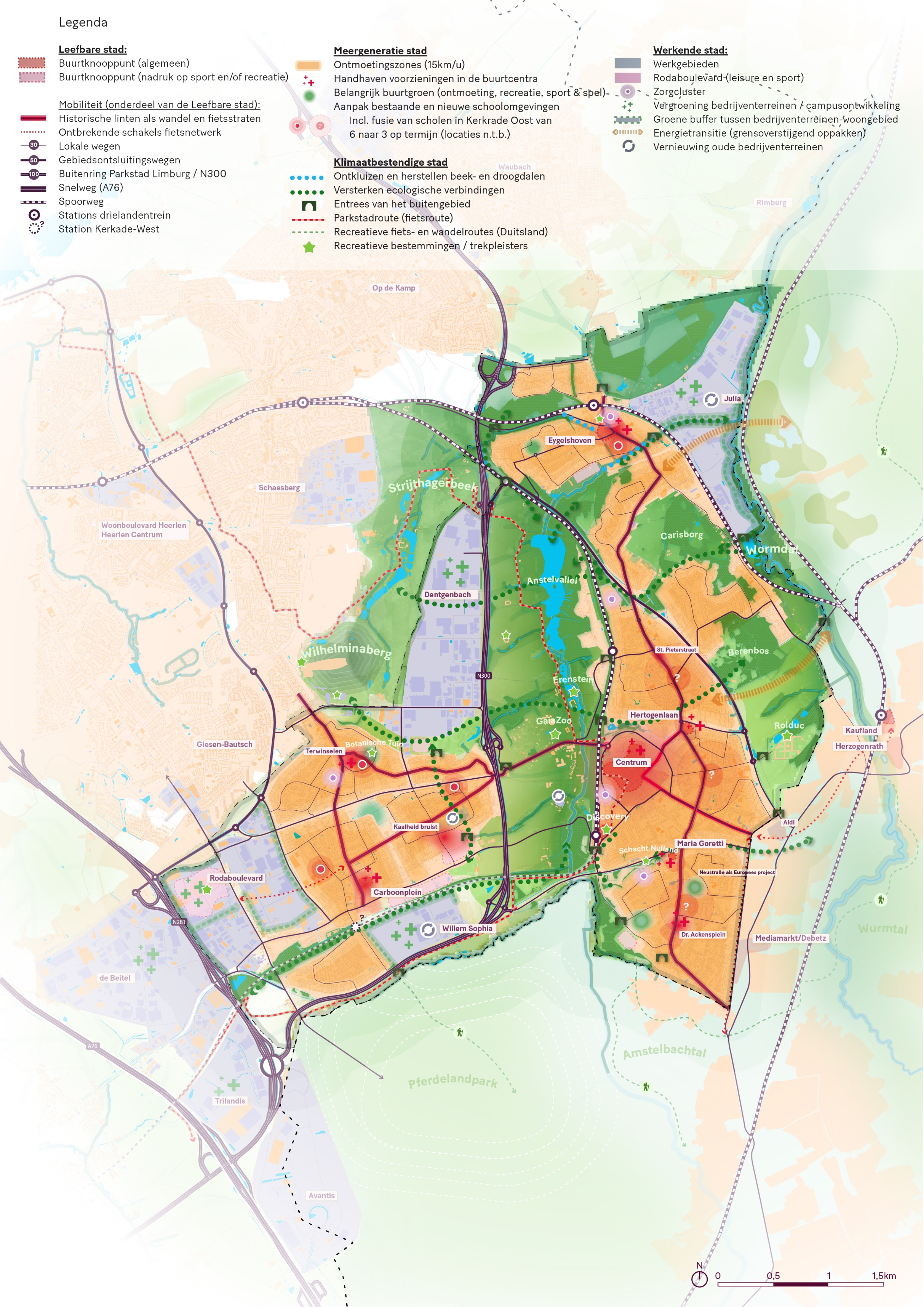
Vision card
Liveable city

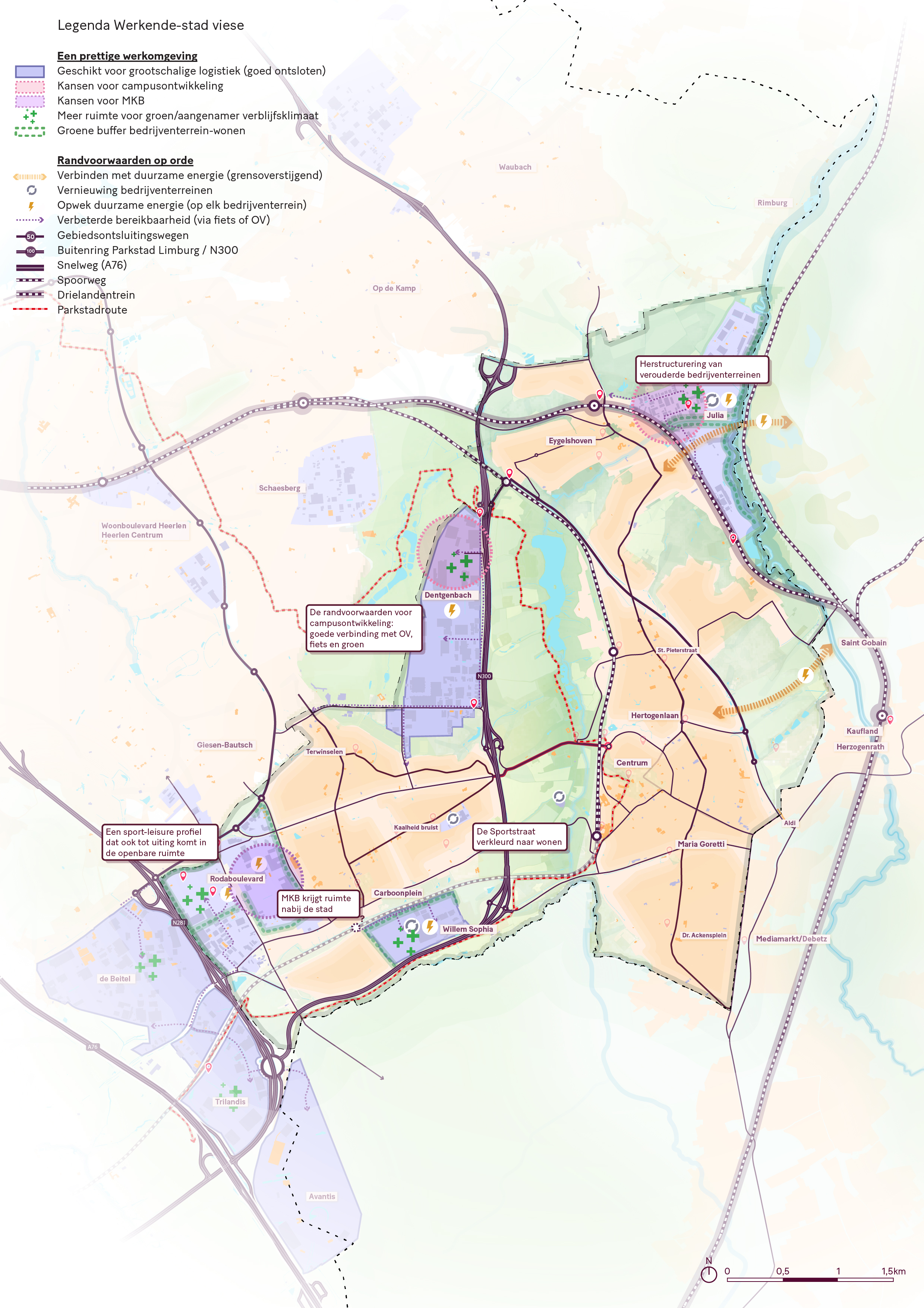
Working city
Multi-generational city
Climate-resilient city
Text versions Maps the four storylines
Vision card
The vision map shows all spatial points of interest and changes for Kerkrade.
Liveable city
- Neighborhood hub (general)
- Neighborhood hub (emphasis on sports and/or recreation)
Mobility (part of the Liveable City)
- Historic ribbons as walking and cycling routes
- Missing links in the bicycle network
- Local roads
- Area access roads
- Buitering Parkstad Limburg / N300
- Highway (A76)
- Railway
- Three-country train stations
- Kerkrade-West Station
Working city
- Areas of expertise
- Rodaboulevard (leisure and sports)
- Healthcare cluster
- Greening of business parks / campus development
- Green buffer between industrial estates and residential areas
- Energy transition (cross-border approach)
- Renovation of old industrial sites
Multi-generational city
- Meeting zones (15 km/h)
- Maintaining facilities in community centers
- Important neighborhood green space (socializing, recreation, sports & games)
- Approach to existing and new school environments
- Including merger of schools in Kerkrade East from 6 to 3 in the long term (locations to be determined)
Climate-resilient city
- Deforestation and restoration of stream valleys and dry valleys
- Strengthening ecological connections
- Entrances to the outskirts
- Parkstad Route (cycling routes)
- Recreational cycling and hiking routes (Germany)
- Recreational destinations / attractions
Liveable city
TheMap where spatial issues or changes play a role in the Liveable City storyline.
Important neighborhood hubs
- Neighborhood hub (general)
- Neighborhood hub (emphasis on sports and/or recreation)
A mobility network with space for bicycles
- Historic ribbons as walking and cycling routes
- Missing links in the bicycle network
- Park City Route
- Search area for alternative access road
- Local roads
- Area access roads
- Buitering Parkstad Limburg / N300
- Highway (A76)
A mobility network that is easily accessible by public transport and shared transport
- Mobility hub
- Railway and station
- Three Countries Train
The most important spatial considerations or changes:
- Eygelshoven: opportunities around stations (the Drielanden train passes through here)
- Dentgenbach: improving accessibility to the business park from the station
- Wormdal: safe and attractive ribbon roads connect the centers. More space for cyclists.
- Center: shared transportation (including bicycles) distributed throughout the city
- Maria Goretti Square: new school locations easily accessible by bicycle and close to amenities
- Rodaboulevard: Cycling and walking route between the city and Rodaboulevard
- Spelholzerheide stop: station location remains interesting
- Southern end of Parkstadroute: connecting work location via Parkstadroute
Working city
TheMap where spatial issues or changes play a role in the Working City storyline.
A pleasant working environment
- Suitable for large-scale logistics (well accessible)
- Opportunities for campus development
- Opportunities for SMEs
- More space for greenery/more pleasant living environment
- Green buffer between industrial estate and residential area
Preconditions in order
- Connecting with sustainable energy (cross-border)
- Renovation of industrial estates
- Generation of sustainable energy (at every business park)
- Improved accessibility (by bicycle or public transport)
- Area access roads
- Buitering Parkstad Limburg / N300
- Highway (A76)
- Railway
- Three Countries Train
- Park City Route
The preconditions for campus development
- Good connections to public transport, cycling, and green spaces
The most important spatial considerations or changes:
- Julia site Eygelshoven: restructuring of outdated industrial sites
- Kaalheide: Sportstraat is changing into a residential area
- Rodaboulevard: SMEs get space near the city
- Rodaboulevard: a sports and leisure profile that is also reflected in the public space
Multi-generational city
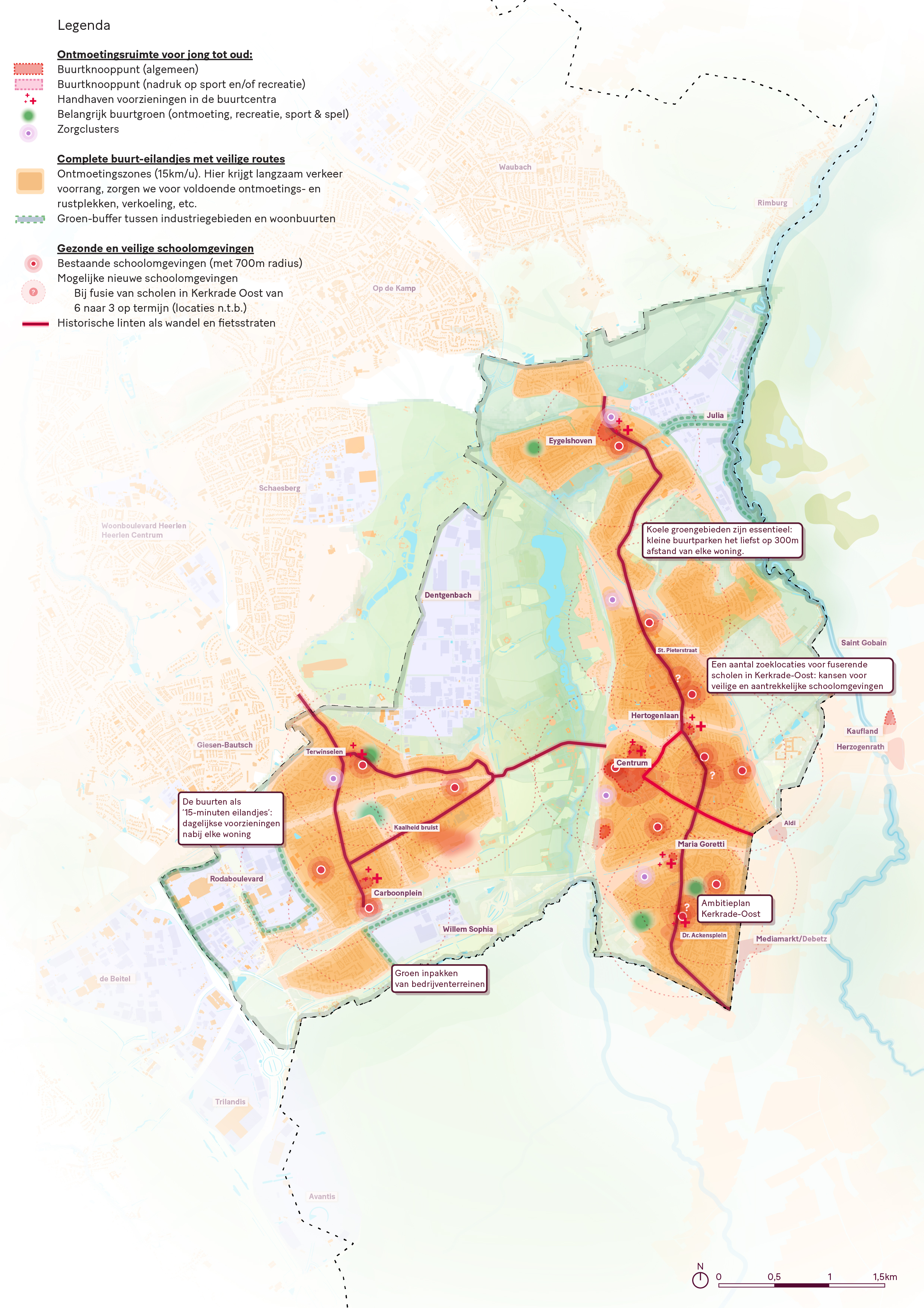
TheMap where spatial considerations or changes play a role in the Multigenerational City storyline.
Meeting place for young and old
- Neighborhood hub (general)
- Neighborhood hub (emphasis on sports and/or recreation)
- Maintaining facilities in community centers
- Important neighborhood green space (socializing, recreation, sports & games)
- Healthcare clusters
Complete neighborhood islands with safe routes
- Meeting zones (15 km/h). Here, slow traffic has priority, and we provide sufficient meeting and rest areas, cooling facilities, etc.
- Green buffer between industrial areas and residential neighborhoods
Healthy and safe school environments
- Existing school environments (within a 700 m radius)
- Possible new school environments
When schools in Kerkrade East merge from 6 to 3 in the long term (locations to be determined) - Historic ribbons as walking and cycling streets
The most important spatial considerations or changes:
- Eygelshoven: cool green areas are essential: small neighborhood parks, preferably 300 meters away from every home.
- Rolduckerveld: a number of locations for merging schools in Kerkrade-Oost: an opportunity for safe and attractive school environments.
- Rodeboulevard: neighborhoods as "15-minute islands": daily amenities close to every home.
- Willem-Sophia: green packaging of business parks.
- Kerkrade-East: Kerkrade-East ambition plan.
Climate-resilient city
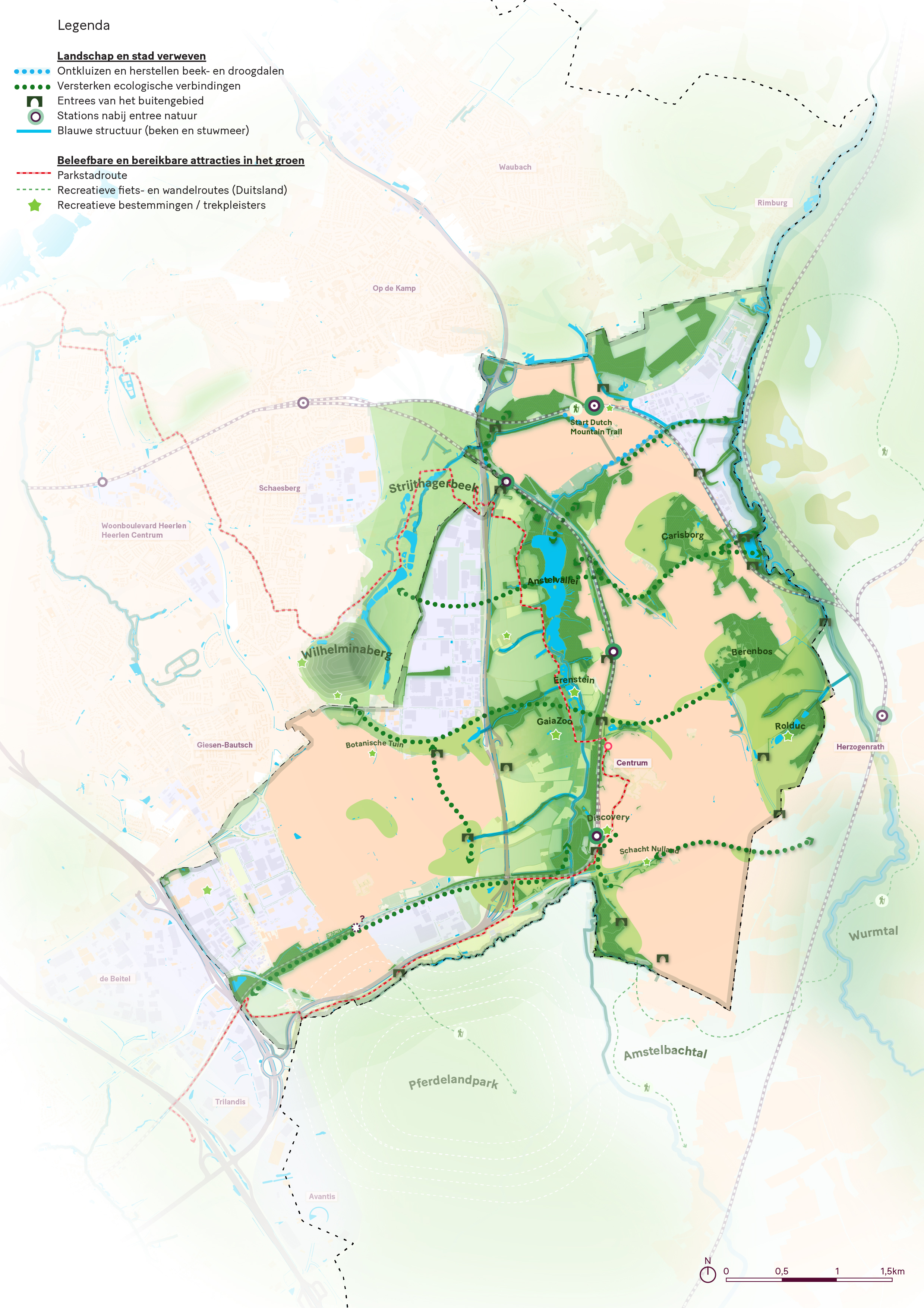
TheMap where spatial considerations or changes play a role in the Climate-Proof City storyline.
Landscape and city intertwined
- Deforestation and restoration of stream valleys and dry valleys
- Strengthening ecological connections
- Entrances to the outskirts
- Stations near nature entrance
- Blue structure (streams and reservoir)
Experiential and accessible attractions in green surroundings
- Park City Route
- Recreational cycling and hiking routes (Germany)
- Recreational destinations / attractions